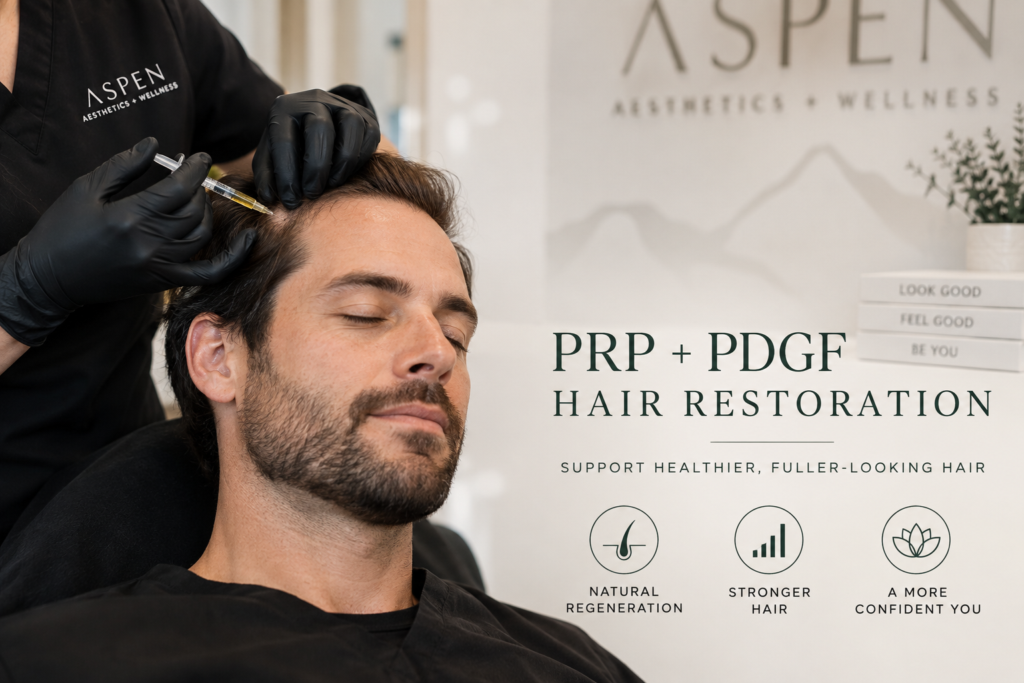
PDGF hair restoration is a non-surgical option for thinning hair that works by concentrating your own body’s growth factors and reintroducing them to the scalp. At Aspen Aesthetics + Wellness, it’s one of two regenerative options for hair loss, the other being PRP, and providers often use them together, with the goal of slowing shedding and supporting a fuller, healthier-looking scalp over time. Hair thinning is common, and it’s rarely just about the hair itself. It’s frequently connected to what’s happening elsewhere in the body, which is why an honest assessment comes before any plan.
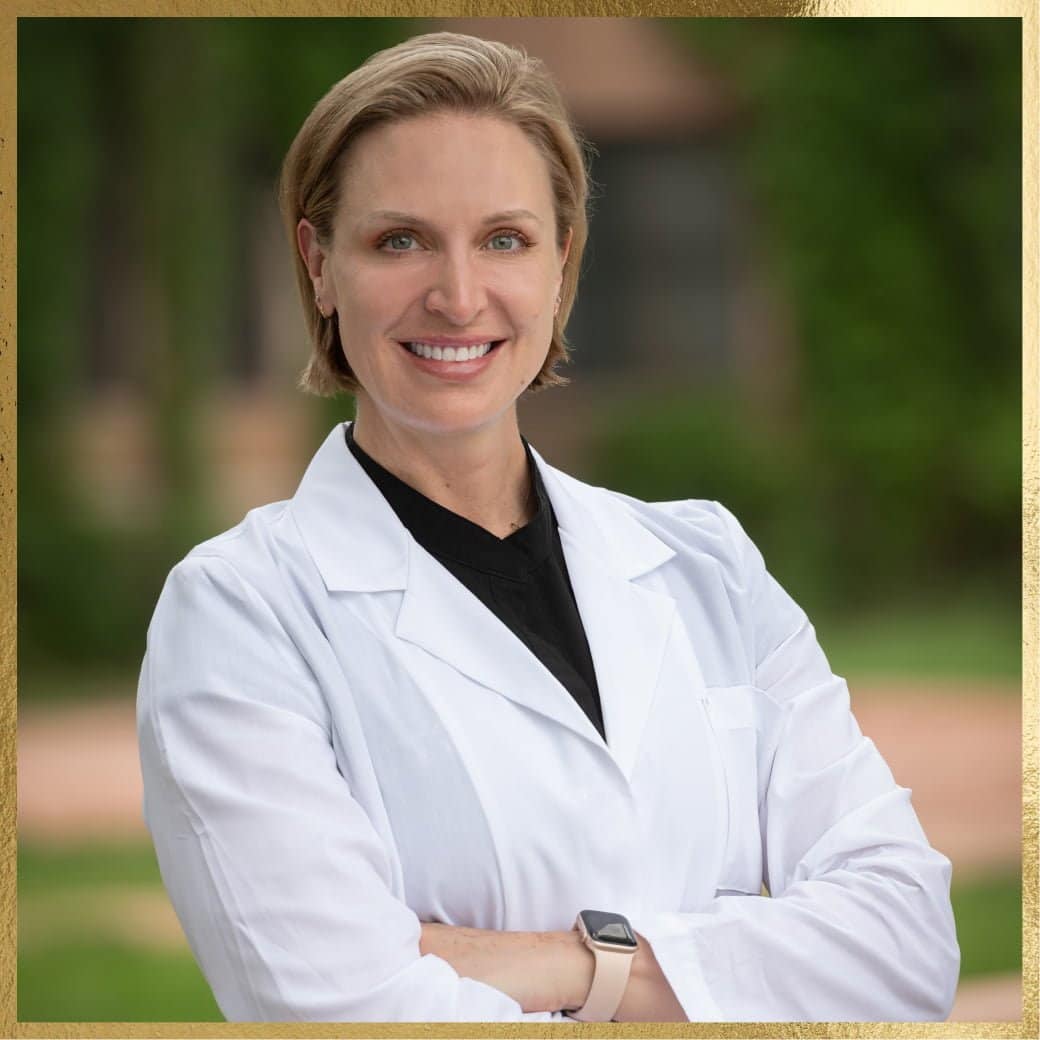
Reviewed for medical accuracy. Hair restoration protocols at Aspen Aesthetics + Wellness are reviewed and supported by Kelly McKay, MSN, APRN, CRNA, Owner and Clinical Director.
Hair loss isn’t one condition with one cause. Hormonal shifts, genetics, chronic stress, nutritional gaps, and age can all play a role, sometimes alone and sometimes stacked together. That’s part of why a one-size-fits-all treatment rarely works well. Two people with a receding hairline can be dealing with entirely different underlying causes, and the right plan depends on figuring out which one applies before deciding on PRP, PDGF, or a combination of the two.
PRP, or platelet-rich plasma, is the more established of the two options. A small blood sample is drawn and spun in a centrifuge, which separates and concentrates the platelets. Those platelets carry growth factors your body already uses to heal and regenerate tissue. Introduced to the scalp, they can support circulation around the follicle and encourage a healthier growth environment. PRP has been used in hair restoration for years, and it has a real research base behind it; more on that below.
PDGF, platelet-derived growth factor, comes from the same blood draw as PRP, but the sample is processed further to isolate the growth-factor component on its own, without the full platelet portion that PRP keeps. Some providers prefer this more concentrated growth-factor profile. In practice, PRP and PDGF aren’t competitors so much as two tools from a shared source. Your provider can help determine whether PRP, PDGF, or a combined approach fits your specific pattern of thinning.
Hair restoration works best when the follicles involved are still active, not gone. A consultation is where that gets sorted out, but a few patterns tend to respond well.
Catching thinning early, before an area has fully stopped producing hair, gives PRP and PDGF the most to work with. A widening part or reduced density on the crown is often one of the first visible signs, and it’s also one of the more responsive patterns to treat.
A hairline that’s pulling back or losing its defined edge is a common reason people look into regenerative options. Results vary depending on how established the pattern already is, which is exactly why an assessment comes before a treatment plan, not after.
Hair changes tied to hormonal shifts, high-stress periods, or nutritional gaps are common, and so is hair thinning connected to rapid weight loss, including from prescription weight management medications. It’s a pattern showing up more often in consultations these days, and worth mentioning specifically if it applies to you, since the underlying cause shapes the plan.
PRP has the deeper research base of the two. Recent systematic reviews in androgenetic alopecia have found meaningful increases in hair density compared to placebo, and that evidence base keeps growing. PDGF’s role is understood at the biological level too. Research on hair follicle stem cells shows PDGF signaling helps regulate the cells that keep follicles active, which is part of the rationale for using it. But PDGF-specific research in hair restoration is newer and smaller than PRP’s, so the honest read is that the science is promising, not settled. Many patients report improvement with both approaches. Neither is a guarantee, and results depend on the individual.
Every plan starts with a consultation and a review of your health history and pattern of loss. On treatment day, a small blood sample is drawn and processed, the scalp is cleansed, and a numbing option is available if you’d like one. The prepared solution is applied to the target areas, often alongside scalp microneedling, which creates tiny channels that help the growth factors absorb and adds its own stimulation to the skin. Most people are back to their normal day afterward, with mild, short-lived redness or tenderness at most. Results build gradually, and there’s no fixed number of sessions that applies to everyone. It depends on how much active follicle activity remains and how your scalp responds.
Hair thinning is often a symptom of something happening elsewhere, not just a scalp problem. That’s why hair restoration at Aspen can be paired with IV and IM nutrient therapy to help address nutritional gaps that may be part of the picture. It’s the same logic behind Aspen’s Microneedling PRP Facial, applied to the scalp instead of the face: treat the visible symptom and the likely cause together, not one without the other.
A regenerative treatment is still a medical one. Health history gets reviewed before anything is drawn or injected, technique matters for both comfort and results, and expectations get set honestly instead of oversold. That’s the standard at Aspen, where hair restoration protocols are reviewed under Kelly McKay’s oversight as clinical director.
If thinning hair has been on your mind, PDGF hair restoration and PRP are worth a real conversation, not a guess. Aspen’s approach starts with an honest look at your hair, your history, and what’s actually driving the change, then builds a plan around that. Book a consultation to find out what fits.
This was my first ever chemical peel, and Kelly was great! She is so educational and helpful in explaining the process and all of the following steps + skincare. I can’t wait to see my results and follow up with her again!

Monday 9 AM–5 PM
Tuesday 9 AM–5 PM
Wednesday 9 AM–5 PM
Thursday 9 AM–5 PM
Friday 9 AM–5 PM
Saturday 9 AM–5 PM
Sunday 10 AM–3 PM

Thursday, November 5
Join us for our open house from 5:30 to 8:30 PM. RSVP to be entered in over $5,000 in giveaways, including a year of Tox.
RSVP now